
Finite Element Analysis
Virtual prototypes
with FEM analyses
With FEM simulation, we prevent expensive errors that later become a problem as early as the design phase. Our detailed calculation of components and optimisation using FEM identifies potential weak points before they become expensive prototypes. From static and dynamic stress analysis to lightweight design, our experts use Ansys and Nastran to provide precise durability calculations and topology optimisation. Whether it’s sports equipment or complex steel structures, we provide a material and cost-efficient structural solution based on strength verification and bionics principles.
Static strength
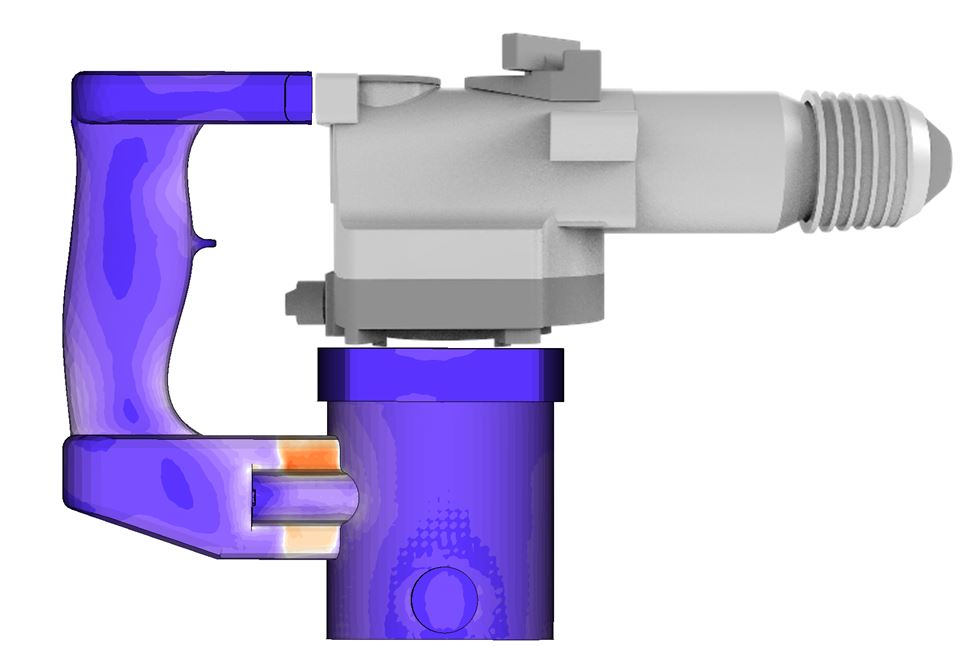
The aim of a static strength verification is to determine the load-bearing capacity of a structure with regard to one-off or infrequently occurring loads. The proof is provided if the load-bearing capacity of the structure is higher than the loads occurring. The progression of the load effect over time is not explicitly taken into account.
A wide variety of influences can be taken into account in the FEM simulation:
– Linear and non-linear material models
-Non-linear contact
-Large deformations
-Buckling/buckling (linear and non-linear)
-Creep
Products / Applications:
– Static and fatigue verification of presses
– Component fatigue of surface-hardened shafts
– Explosion pressure shock resistance of pressure vessels, chutes, ducts and machines
– Stability verification of production lines
– CE-compliant strength verification of hoists
– Verification of fasteners: bolts, weld seams, etc.
– Proof of stability in the event of wind, snow and earthquakes
– Proof of the tilt resistance of systems
– Static test for plastic components
Thermal FEM analysis
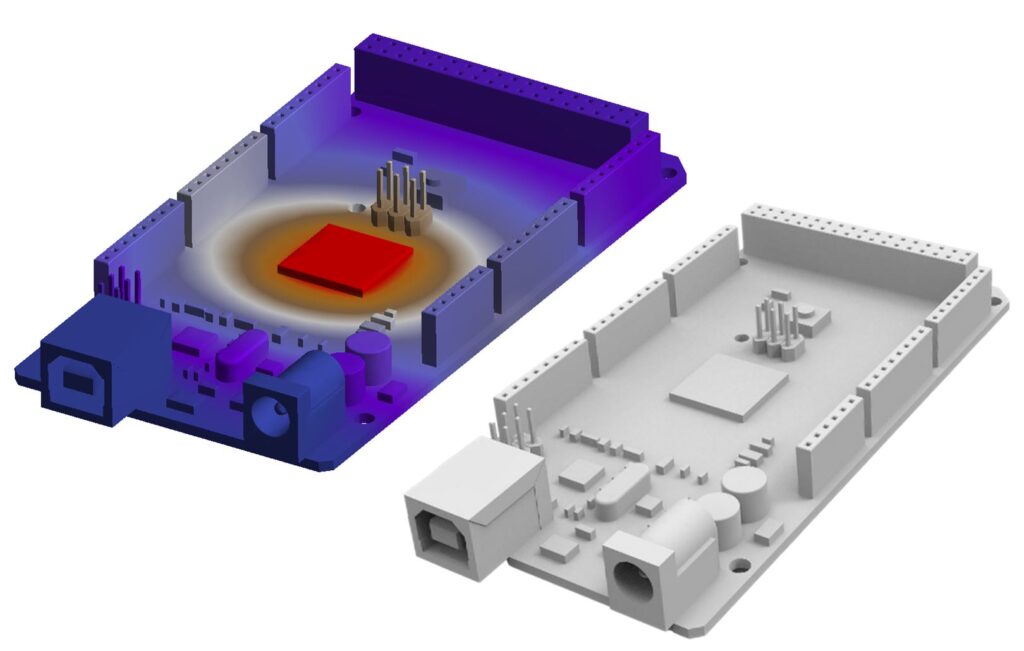
FEM simulations are used to calculate the resulting temperature distributions and heat flows. In principle, the effects of a flow, e.g. with free or forced convection, can also be modelled in the form of boundary conditions. In addition to temperature distributions, thermal analyses also record the effects on the mechanics of a component or assembly. Thermal effects can cause expansions, loads and stresses which, depending on the application, can be critical for safe operation.
With the following analysis disciplines from the field of FEM calculation, we can help you to visualise and better understand the temperature-related relationships in your component:
– Stationary state of the temperature distribution
– Temporal course of the temperature distribution (transient)
– Component deformations due to the temperature change
– Thermal stresses and strains
Products / Applications:
– Simulation of heating and cooling processes of pumps, valves, pressure vessels, reactors (incl. strength assessment of thermal stresses)
– Calculation of transient temperature field and thermal stresses during thermal shock of components from the LNG sector
– Deformations of machine tools due to temperature gradients (machining accuracy)
– Behavior of the gap dimensions of pumps during short-term overheating
– Simulation of heating elements (Joule heat)
– Thermal analysis of shielding plates / heat shields
Dynamics, vibrations
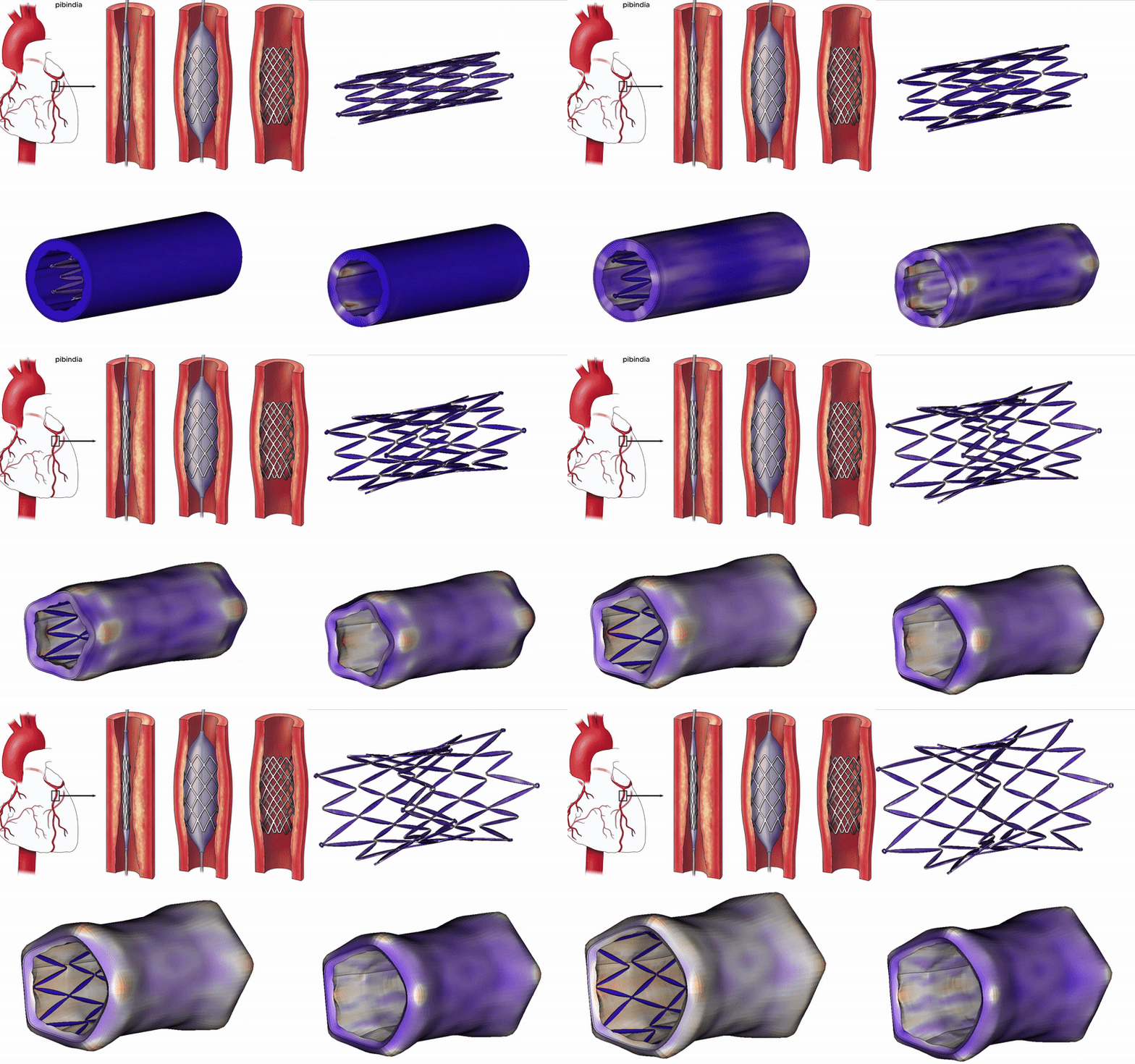
Structures can be excited to vibrate by external loads. If excitation occurs in the range of a natural frequency of the structure, it can vibrate. A resonance catastrophe occurs and the structure fails. Fatigue failure can also occur if the design is incorrect.
In order to find the optimum solution for your problem, our calculation engineers use various methods of vibration analysis:
– Modal analyses to determine natural frequencies
– Frequency response analyses for sinusoidal loads
– Response spectrum methods for earthquake calculations
– PSD analyses for vibrations and random vibrations
– Transient analyses for arbitrary and time-varying loads
Products / Applications:
– Natural frequencies of vehicle components (e.g. common rails)
– Earthquake calculation and stability analyses): Containers, aggregate base frames, etc.
– Strength assessment of engine and gearbox components
– Vibration analyses of vehicle components (motor vehicles, rail, aviation)
– Simulation of vibrating tables (e.g. from screening and mixing technology)
– Containment simulation (enclosing component must not be penetrated)
– Explosion calculations
– Simulation of shock tests
– Drop and crash tests
– Simulation of pressure pulsations in containers and reactors
– Transient simulation of ship loaders (wave movements)
– Multi-body simulations
Flow simulation
CFD simulation mathematically simulates flows and flow patterns. The visualization of flow paths with CFD software reveals weak points in the flow control, which in turn allows the efficiency of products and processes to be optimized.
In order to assess these interactions, we use the appropriate method for your problem in our FEM simulations:
– Internal flows in closed systems such as pipes or valves
– External flows around components and assemblies, such as the flow around an airfoil
– Investigation of Newtonian and non-Newtonian fluids
– Rotating components such as impellers
– Thermal investigations with heat transfer in solids and strength calculations
– Conducting particle studies to investigate the behavior (e.g. of solid particles in a fluid flow) e.g. of solid particles in a fluid flow)
– Modification and optimization of structures
– Building climatology and investigation of air humidity
– Transfer of the results to FEM calculations; implementation of the associated FEM calculations
Products / Applications:
– Detailed simulation of wind loads
– Wave loading offshore platforms
– Simulation of tank sloshing
– Simulation of pressure pulses caused by passing trains or vehicles
– Calculation of vortex excitations in mechanical and plant engineering
– Behavior of an aerofoil in an air flow
– Flow between the sipes on a car tire
– Simulation of plastic damping elements
The following standards and regulations serve as the basis for the strength analysis and strength verifications:
EuroCode 1, EuroCode 3, EuroCode 9, DIN 18800,
FKM guideline, DIN 1993, EN 1591, EN 13480
DIN EN 12663, DIN EN 61373, GM/RT2100, BS 7608,
DIN EN 15085, DVS 1608, DVS 1612,
DIN 15018, DIN EN 13001, EN 13155, EN 13445,
VDI 2230, DIN 25201,
AS 1210, Pressure Equipment Directive, AD 2000 – data sheetsThe following standards and regulations serve as the basis for the strength analysis and strength verification: